How to Choose Your First Keyboard or Piano

Starting piano lessons is exciting.
But before you begin, there's often one big question:
Should I buy a keyboard or a piano?
For many beginners (and parents), the number of options can feel overwhelming.
Weighted keys.
Touch sensitivity.
88 keys.
Digital pianos.
Acoustic pianos.
It can quickly become confusing.
The good news is that you don't need to spend thousands of pounds to get started.
Here are some simple things to consider when choosing your first instrument.
🎹 1. You Don't Need an Expensive Piano to Begin
One of the biggest misconceptions is that beginners need a high-end piano.
In reality, many students start successfully on:
digital pianos
electronic keyboards
portable keyboards
What's most important is having an instrument you can practise on regularly.
A modest instrument that gets played every day is far more valuable than an expensive one that rarely gets used.
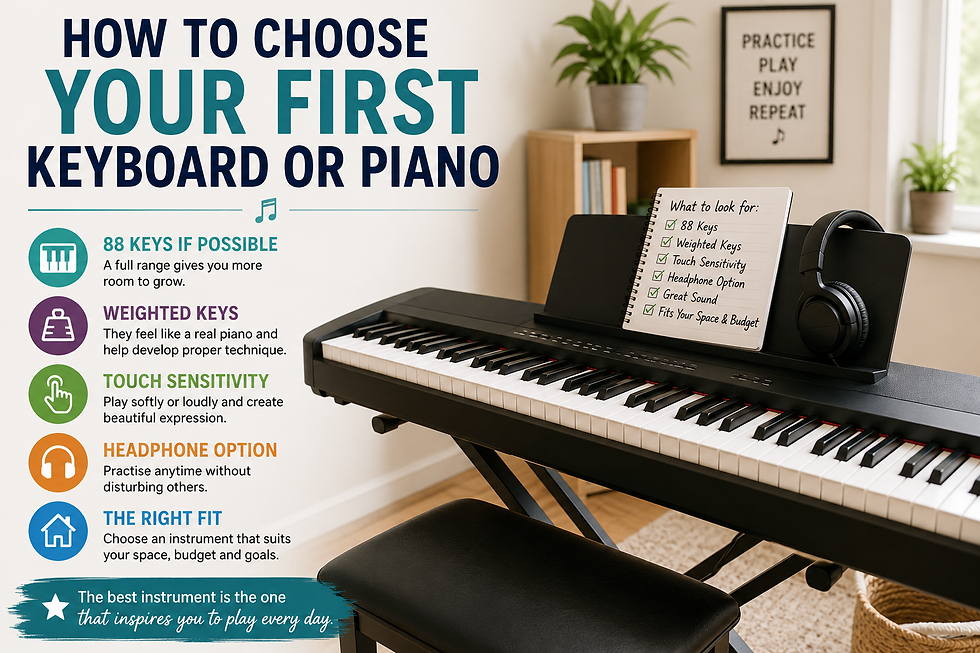
🎵 2. Aim for 88 Keys If Possible
A full-sized piano has 88 keys.
Many beginner keyboards have fewer.
For young beginners, this may not be a problem at first.
However, having 88 keys allows students to:
play a wider range of music
develop proper technique
avoid needing an upgrade too quickly
If your budget allows, a full-sized keyboard is often a worthwhile investment.
👆 3. Weighted Keys Make a Big Difference
When teachers recommend a keyboard, they often mention "weighted keys."
This simply means the keys feel more like those on an acoustic piano.
Weighted keys help students develop:
finger strength
control
technique
musical expression
Without weighted keys, moving to a real piano later can feel quite different.
If you're serious about learning, weighted keys are one of the most important features to look for.
🎶 4. Touch Sensitivity Is Essential
Some cheaper keyboards produce the same volume no matter how hard you press the keys.
This limits musical expression.
Look for a keyboard with touch-sensitive keys.
This allows students to:
play softly
play loudly
develop better control
create more expressive performances
It's a feature that becomes important surprisingly quickly.
🏠 5. Consider Your Available Space
Not everyone has room for an acoustic piano.
Digital pianos and keyboards can be ideal because they:
take up less space
are easier to move
often include headphone options
require less maintenance
For many modern families, a digital piano is the most practical choice.
🎧 6. Headphones Can Be a Lifesaver
This is one feature many parents appreciate.
Most digital pianos and keyboards allow students to practise with headphones.
This means:
early morning practice is possible
family members aren't disturbed
students can focus more easily
For households with busy schedules, this can be a huge advantage.
💷 7. Don't Feel Pressured to Buy the Most Expensive Model
Music shops often display impressive instruments with endless features.
Many of those features are unnecessary for beginners.
Students rarely need:
hundreds of instrument sounds
complex recording functions
advanced studio features
A simple, reliable instrument is often the best choice.
Focus on quality rather than extra features.
🎹 8. Acoustic Pianos Have Their Own Advantages
If you have the space and budget, an acoustic piano can be wonderful.
Many players love:
the natural sound
the physical feel of the keys
the resonance of the instrument
Acoustic pianos can provide a unique playing experience.
However, they also require:
regular tuning
more space
greater financial investment
For many beginners, a digital piano offers a practical alternative.
🌱 9. Think About Long-Term Motivation
When choosing an instrument, ask yourself:
"Will this make me want to practise?"
The best instrument is often the one that encourages regular use.
Students are more likely to stay motivated when their instrument:
sounds good
feels comfortable
is easy to access
fits naturally into daily life
Practicality often matters more than perfection.
⭐ 10. Ask Your Teacher Before Buying
Perhaps the simplest advice of all:
Ask your teacher.
Music teachers help beginners choose instruments all the time.
They can often recommend options that:
suit your budget
fit your available space
support your musical goals
A quick conversation can help you avoid expensive mistakes.
🌟 Final Thoughts
Choosing your first keyboard or piano doesn't need to be complicated.
For most beginners, the ideal instrument includes:
88 keys
weighted keys
touch sensitivity
a sound you enjoy listening to
Beyond that, the most important thing is simply having an instrument that encourages regular practice.
Remember:
A beginner doesn't need the perfect piano.
They simply need a good instrument and the enthusiasm to start playing.
The instrument can always be upgraded later.
The most important step is making music today.


Comments