Why Traditional Piano Teaching Turns More Children Off Than It Helps

Updated: May 26
If you’ve ever had a child start piano lessons and then lose interest within a few months, you’re not alone.
Many parents assume the problem is motivation, discipline, or “not being musical enough.”
But in reality, the issue is often something else entirely:
The way piano is traditionally taught doesn’t suit how many children actually learn.
That doesn’t mean traditional teaching is “bad”, but it does mean it isn’t always the right fit for modern learners, especially beginners.
Let’s break down why.
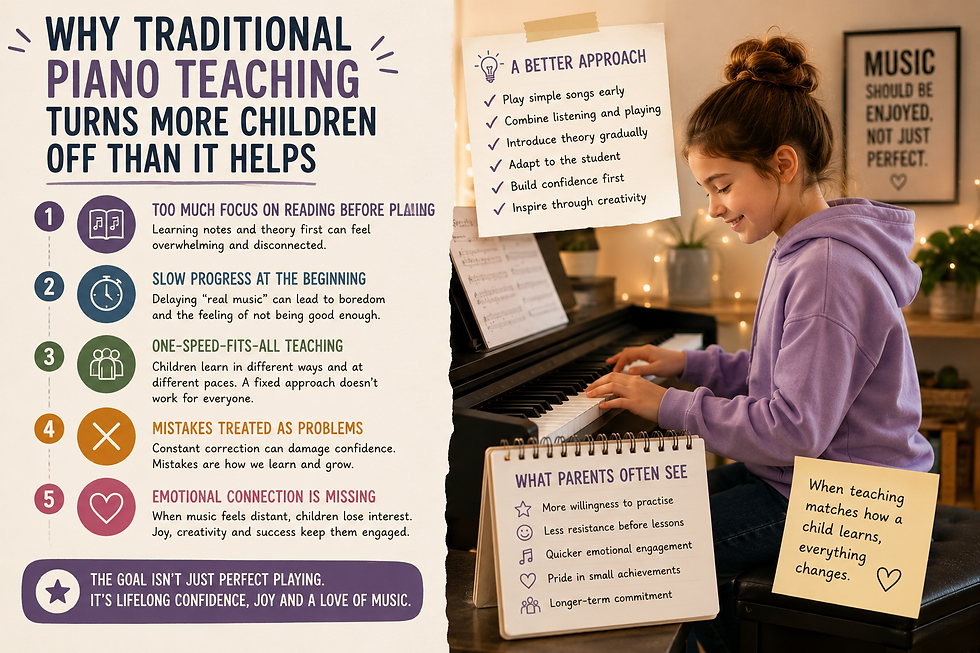
🎹 1. Too much focus on reading before playing
One of the most common traditional approaches is:
learn notes → learn theory → then play music
For many children, this feels like learning to read a language before ever speaking it.
Some students enjoy this structure. But many others:
lose interest quickly
feel overwhelmed by notation
don’t connect theory to sound
struggle to see progress
Modern learners often respond better when they can:
play first → understand later
Early sound, rhythm, and simple patterns can build far more engagement than pages of notation alone.
🎵 2. Slow progress at the beginning can kill motivation
Beginners often want one thing early on:
“I want to play real music.”
Traditional methods sometimes delay this by focusing heavily on technical foundations.
While technique is important, the emotional reality is:
If a child doesn’t feel like they are making music, they often assume they are not good at it.
This is one of the biggest reasons beginners stop.
Small wins matter more than perfect form in the early stages.
🧠 3. One-speed-fits-all teaching doesn’t reflect how children learn
Traditional piano teaching often follows a set progression regardless of the student:
same method book
same pace
same expectations
same structure
But children are not uniform learners.
Some are:
highly visual learners
pattern-based thinkers
confident experimenters
cautious and anxious learners
highly auditory learners
A fixed system can unintentionally:
bore faster learners
overwhelm slower processors
miss creative learners entirely
Flexible teaching tends to keep more students engaged long-term.
🎶 4. Mistakes are often treated as problems instead of learning tools
In some traditional settings, mistakes are corrected quickly and repeatedly.
While accuracy matters, beginners can interpret this as:
“I’m doing it wrong”
“I’m not good at this”
“I should be better already”
In reality, mistakes are essential in music learning.
A healthier approach is:
explore → adjust → improve → repeat
This keeps confidence intact while still building skill.
🎸 5. Emotional connection to music is sometimes missing
Children rarely stay engaged with music just because it is “good for them.”
They stay engaged because:
they like the sound
they recognise songs they enjoy
they feel progress
they feel successful
they enjoy the experience
Traditional methods can sometimes become so focused on correctness that the music itself feels distant.
But music is an emotional experience first, and a technical skill second.
🌱 So does this mean traditional piano teaching is wrong?
Not at all.
Many students thrive with structured, exam-focused approaches. They enjoy clear expectations and step-by-step progression.
The key issue is fit, not superiority.
The real question is:
Does this teaching style match how the child learns best?
🎹 What modern, child-centred piano teaching often looks like instead
More flexible approaches usually include:
learning simple songs early
combining listening and playing
introducing theory gradually
adapting pace to the student
focusing on confidence first
using creativity alongside structure
This doesn’t remove standards, it just changes the entry point.
👨👩👧 What parents often notice when the approach is right
When teaching aligns with the learner, parents often see:
more willingness to practise
less resistance before lessons
quicker emotional engagement
pride in small achievements
longer-term commitment
Most importantly, children begin to see themselves as “someone who can do music.”
That identity shift is powerful.
🎯 Final thought
The goal of piano lessons isn’t just to produce technically correct players.
It’s to create learners who:
enjoy music
feel confident
stay engaged long-term
and grow into independent musicians
If a child stops enjoying piano, it’s rarely because they “can’t do it.”
More often, it’s because the teaching approach hasn’t matched their learning style yet.
And when that match is right, everything changes.


Comments